Spot drift before the deadline
Loop watches the gap between plan and actuals continuously, so you see drift and dependency risk while there’s still time to act, not at the next review.
Loop brings human and agent work, strategic goals, and business data into one model.
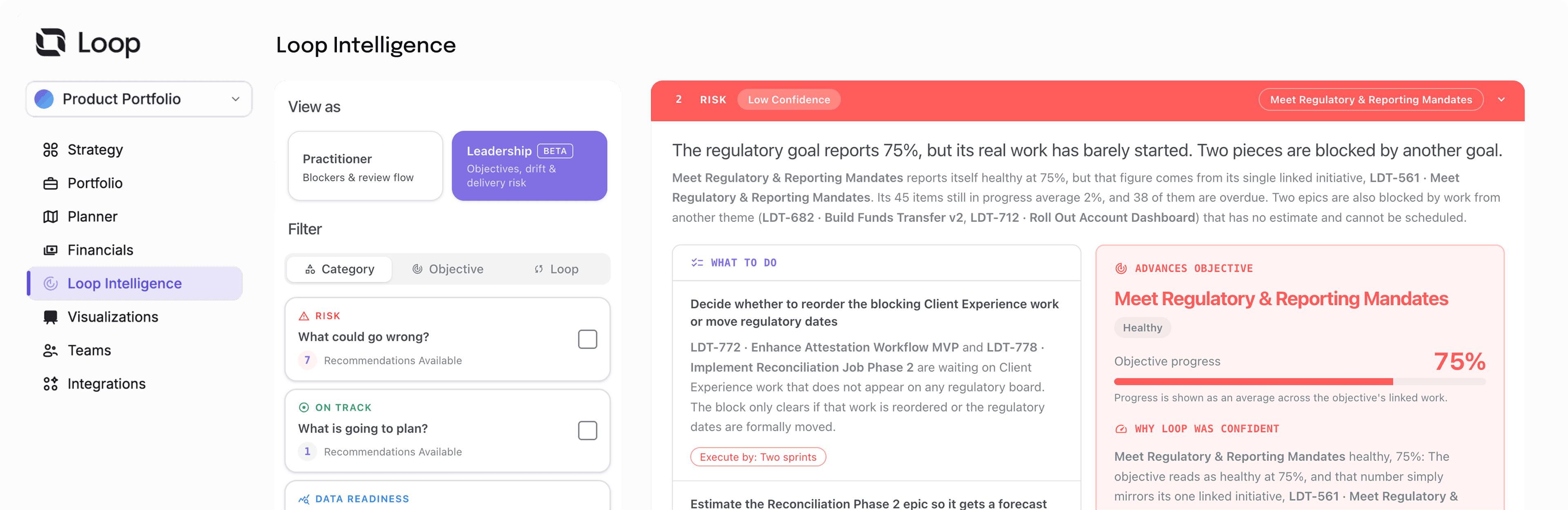
Connect your people, agents, budget, and delivery to your goals. Loop gives you clear next moves that get sharper with every decision.
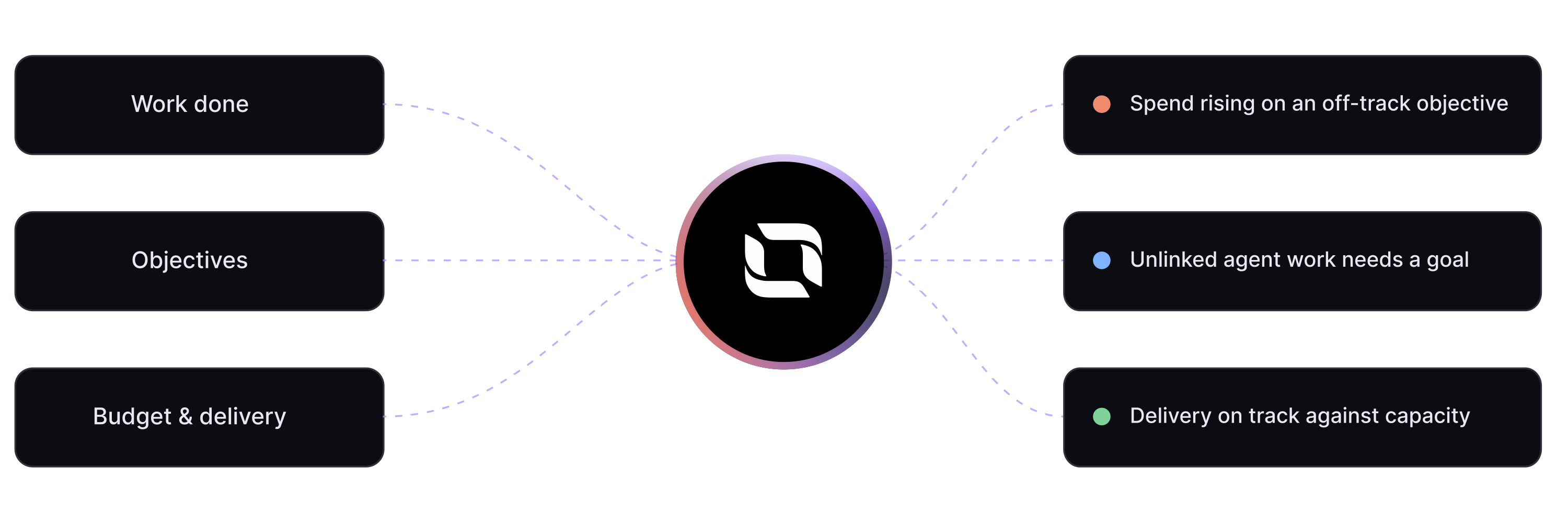
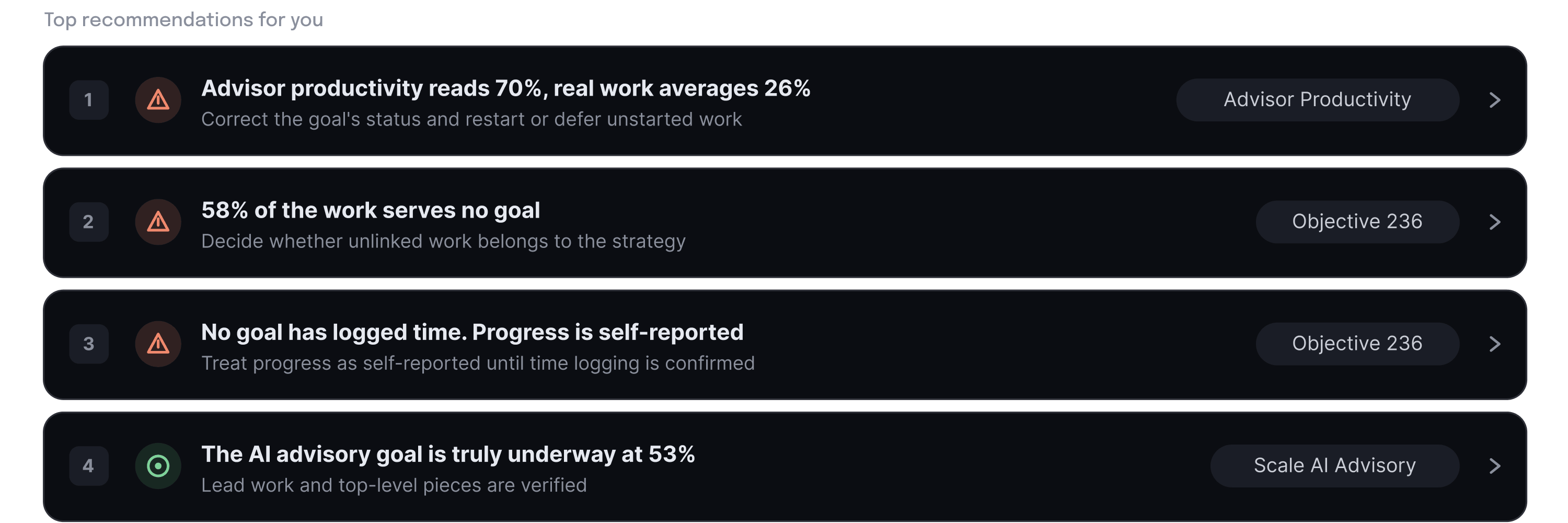
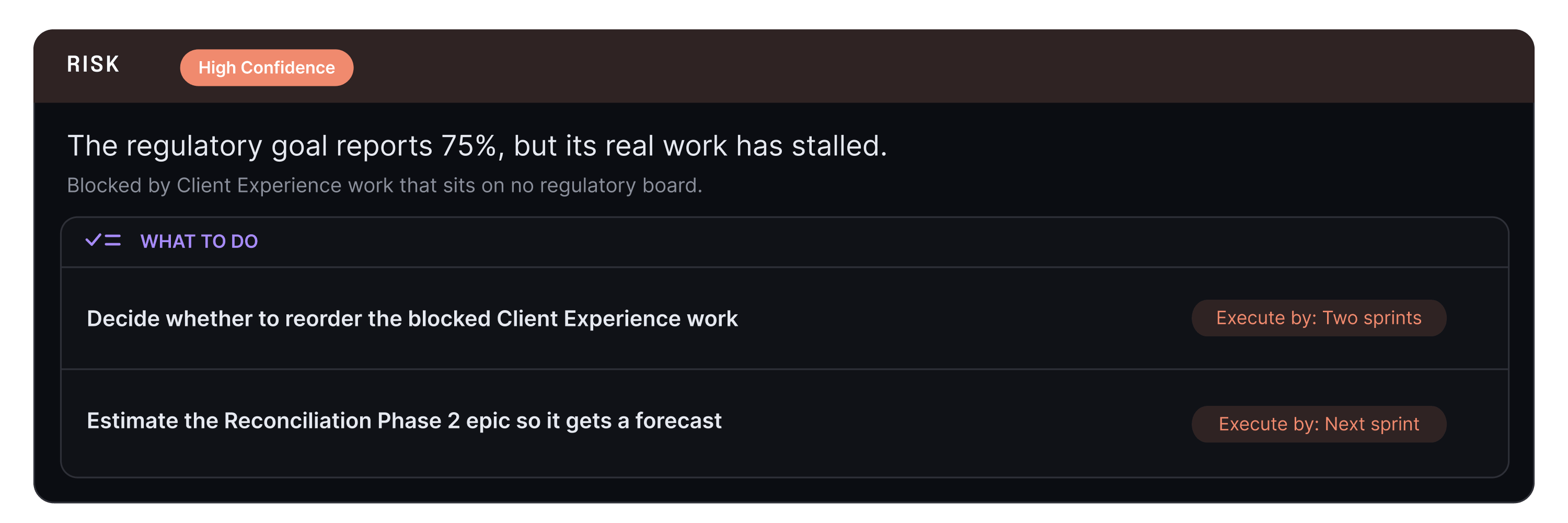
Loop watches the gap between plan and actuals continuously, so you see drift and dependency risk while there’s still time to act, not at the next review.
Every finding shows its confidence level, the work items it affects, and the sources behind it.
Choose how much Loop does on its own, from surfacing findings to running pre-approved actions inside guardrails you set.
Loop learns from your decisions and their outcomes, so recommendations fit how your organization runs. That learning stays within your organization, and your data is never used to train public AI models.
Loop MCP connects Claude and other MCP-enabled AI tools to your portfolio. Practitioners see blockers and review flow. Leaders see objectives, drift, and delivery risk.
Couldn't find what you need?Go to our documentation
Start with two or three real initiatives. Trace each one from strategic objective through investment, capacity, delivery, and outcome. Then change a priority and watch what the tool does. That shows you whether it reports on the portfolio or helps you decide.
Planview Portfolios, Planisware, ServiceNow SPM, Jira Align, and BigPicture all include financial or investment-management capabilities. The depth varies, so test the budgeting, forecasting, capitalization, and approval workflows you actually need.
Product management systems are digital tools used by product teams to oversee every phase of the product lifecycle. They cover idea generation, customer feedback, sprint execution, releases, and post-launch analytics.
The systems help align strategy, execution, and stakeholder communication into a cohesive, manageable workflow.
Core functions
Idea and backlog management captures, prioritizes, and organizes feature ideas, requests, and roadmap items in a central repository.
Product roadmapping builds and shares high-level visual roadmaps that align product strategy across teams.
Task and sprint tracking creates prioritized backlogs, manages user stories, and tracks progress using Scrum or Kanban boards.
Automations reduce friction and manual workload by automating routine tasks or transitions.
Collaboration and documentation hosts your product requirement documents, briefs, meeting notes, and feedback loops in integrated or partnered doc tools like Jira with Confluence, ClickUp docs, or Notion.
Integrations connect to analytics tools, design apps like Figma, Slack or Teams, code repositories, and feedback platforms.
Benefits for product teams
Product management systems streamline workflows and increase efficiency by eliminating scattered tools in favor of centralized planning, execution, and reporting.
One source of truth consolidates roadmap, backlog, feedback, and status reporting into a unified platform. This improves visibility for all stakeholders.
Better alignment and transparency happen through roadmaps and dashboards that help align engineering, design, marketing, and leadership teams on objectives and timelines.
Efficient sprint execution comes from agile tools that make backlog grooming, sprint planning, and progress tracking cleaner and more structured.
Feedback prioritization and decision support happen through systems that enable prioritizing features with built-in feedback loops or AI-driven scoring.
Automated reporting and analytics through custom dashboards track key metrics across teams and sprints, assisting in data-informed decision-making.
Popular tools and use cases
Jira works for agile software development teams with backlog, issue tracking, customizable workflows, and automation.
Asana suits cross-functional product teams with multi-view project tracking, timelines, automation, and collaborative access.
ClickUp provides an all-in-one workspace for documentation, roadmap, and execution. It's highly customizable with built-in docs and AI-supported workflows.
ProductPlan focuses on visual roadmap building and strategic planning with drag-and-drop roadmaps and collaborative feedback tools.
Monday.com handles workflow alignment across product and operations with visual workflows, automations, and cross-team dashboards.
Airfocus, Productboard, and Craft.io support feedback-driven prioritization and product strategy with AI-assisted planning and built-in customer feedback integration.
How product management systems help
The systems accelerate ideation to decision-making with idea capture, prioritization, and alignment using fewer meetings and email threads.
Improved team coordination means everyone knows what's being built, when, and why. Developers, product leads, and stakeholders stay aligned.
Support for agile delivery comes from tools that enable fast sprint cycles and adaptive responses to change.
Track feedback and measure impact through AI-enhanced or feedback-integrated tools that help prioritize based on business value and user needs.
Simplified stakeholder communication happens through visual roadmaps and shared dashboards that keep executives and cross-functional teams in sync.
Choosing the right system
Consider the size and maturity of your team. Jira and ProductPlan suit engineering-heavy teams, while Asana or Monday work well for mixed or non-technical teams.
Look at tools already in use. If your organization uses Confluence or GitHub, Jira integrates seamlessly. ClickUp may align better if docs and tasks need centralization.
Evaluate your need for feedback prioritization. Platforms like Productboard, Airfocus, or Craft.io offer deeper prioritization workflows.
Determine your level of customization needs. ClickUp and Monday allow tailored workflows, while simpler tools may work well for smaller product teams.
The process has four steps: collect feedback across channels, segment it by user type and theme, prioritize the segments that align with your business goals, and connect the top issues to roadmap items with clear owners. Closing the loop – telling users what changed and why – is the step most teams skip, and it’s the one that determines whether customers keep engaging with your feedback process.
Most frameworks cycle through the same loop: define the goal, plan the sprint, build, review and release, learn, repeat. Scrum, Kanban, and SAFe all run some version of this. The terminology is different; the cycle isn't.
Primavera handles resource loading against cost-loaded schedules, which works for capital programs run by dedicated schedulers. It's not built for live capacity planning across Jira-based engineering and product squads. Tempo Capacity Planner extends Jira's data model directly, planning availability-based capacity for individuals and teams – accounting for working hours, holidays, PTO, and existing commitments – and reports utilization and planned vs. actual without a scheduler in the loop.
The pattern repeats. A product leader starts on a free trial, the roadmap becomes the one executives ask to see, and inside a quarter it is how the wider organisation plans.


Read the customer storyTempo helps us collaborate more effectively with finance and deliver sharper insights into capitalization, budgeting, and project performance.
Jamie Stanley, Senior technology program management support analyst, SiriusXM
Reads every signal, turns it into evidence-backed insight.
Visualize all your Jira data & manage portfolios of projects in real-time.
Tempo’s intuitive automation and Jira-native design make it the most trusted time tracking tool for enterprise organization.
A powerful team resource management tool designed to optimize capacity planning and project management in Jira
Monitor projects and portfolios to get simple, clear, and real-time views of your costs, budgets, and profits that can be shared throughout your entire organization.
See how work is progressing and where blockers are with the most flexible reporting app in Jira.
Get a real answer to how far your company is from the plan.


